Magazine
Holiday Advertising 2026: Nielsen Counts Six Times as Many September Creatives as 2021
In September 2026, six times as many holiday TV creatives ran as 2021. Nielsen also shows strong differences between streaming and linear television.
Contents · 3 sections
Holiday advertising starts long before Advent. In the US, six times as many seasonal TV ad creatives ran in September 2026 as in September 2021. Compared with the previous year alone, the number grew by 11 percent. This is according to a new analysis from Nielsen Ad Intel. For media teams planning Black Friday and the holiday season, the early start means that not only budgets but also creative production calendars are shifting.
Nielsen analyzed English- and Spanish-language TV ads featuring holiday themes or promotions around the seasonal sales. In September 2026, roughly one in every hundred linear TV ads already fell into this category.
Retail dominates – and streaming allocates budget differently
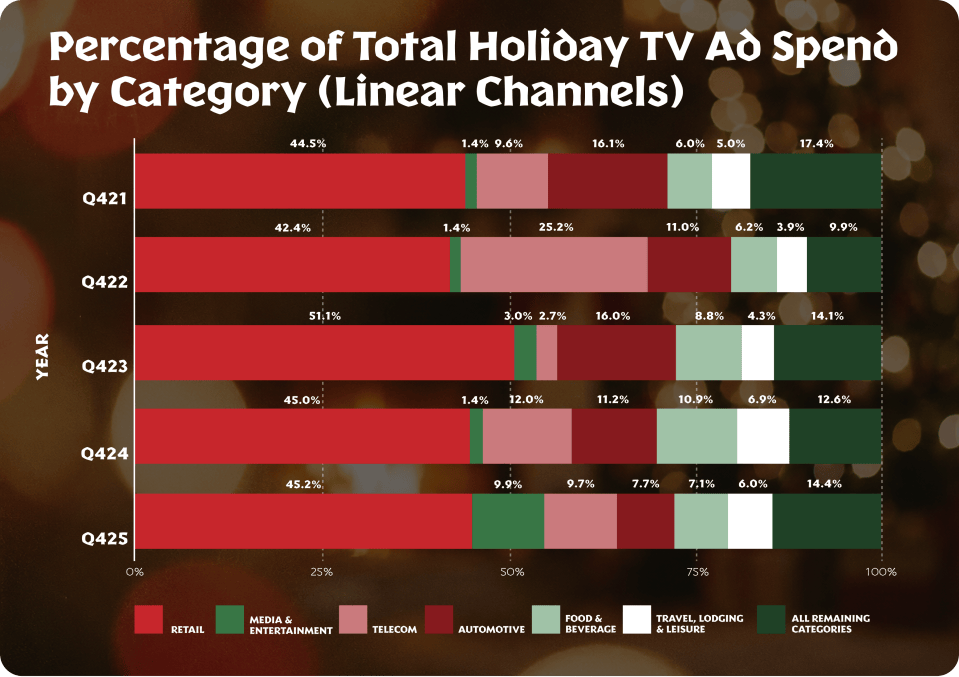
Over five years, retail accounted for on average about 45 percent of linear holiday ad spend in the fourth quarter. Around 34 percent of retail ads explicitly referred to Black Friday or Cyber Monday. In October 2026, retail accounted for 63,7 percent of all seasonal linear ads according to Nielsen – while other industries were only just ramping up their seasonal campaigns.
The picture changes once streaming is added. 2025, holiday ad volume on streaming was roughly half of linear TV volume. Automotive and telecommunications, however, had a higher relative share of seasonal ad spend on streaming than on traditional television.
This means channel choice is not merely a question of which screens an existing spot appears on. The audience, the industry competition and the options for measuring results all differ. A retailer campaign can run in parallel on social, connected TV and retail media surfaces, but each environment needs its own role in the purchase journey.
An early start doesn't mean showing the same spot for six months
Other data also describes a longer shopping and advertising phase. Circana reports that 48 percent of US consumers already browse before Thanksgiving and 47 percent 2025 use their smartphone to search and buy. The Trade Desk observes for the Cyber Five days ad spend on its platform that is 25 percent higher than 2023; the lead-up in the week before Thanksgiving has also intensified.
For social media marketing this suggests a sensible sequencing: early inspiration and brand presence, then more product-focused creatives, and clear offers shortly before the promotion dates. Amazon combines Prime, film and commerce in this year's holiday marketing; Welch’s links social storytelling directly to Instacart. Both approaches use different touchpoints rather than an isolated sales spot.
Nielsen also measures the impact of seasonal advertising
Of interest are the sales lift benchmarks for streaming advertising published by Nielsen 2025: for cosmetics retailers, the measured lift from seasonal campaigns was 3,2 times higher than for average off-season campaigns; for department stores the factor was 2,4, and for restaurants 1,5. These are industry-specific US benchmarks, not forecasts for German advertisers.
A media plan should therefore answer both questions: When does the relevant buying phase begin, and which touchpoint should achieve which effect? Current developments fit the new creator commerce approaches and campaigns that integrate creator videos into the purchase journey.
The American percentage figures cannot be transferred directly to German brands. The strategic lesson is still clear: whoever sends the first message only in Black Friday week competes against brands that have been building awareness and purchase interest for weeks.
Sources: Nielsen Ad Intel – original analysis, November 2026, Circana – Holiday Shopping, The Trade Desk – Cyber Five data.
Image: Original graphic from Nielsen Ad Intel on the distribution of linear holiday advertising spend; © Nielsen.
Source