Magazine
Adobe "Made to Create": 30 creatives from 18 countries instead of the AI look-alike
Adobe launches "Made to Create" with more than 30 creatives from 18 countries. How 72andSunny and Adobe combine AI production, human craft and a global campaign.
Contents · 4 sections
Adobe unveiled the new brand film "Made to Create" at the Adobe MAX conference on November 10, 2026. Rather than putting the most spectacular AI demonstration centre stage, the software company shows the people behind the images: more than 30 creatives from 18 countries contributed to the film. The campaign was created together with the agency 72andSunny and is being expanded beyond the premiere film into further TV and streaming appearances.
The timing is remarkable. Just as Adobe hands more and more creative work steps over to AI agents, human craft is becoming the centre of the brand's communication. For agencies and social teams, the interesting story therefore lies not only in the film but in how it was made.
One film, many visual languages – and the artists remain visible
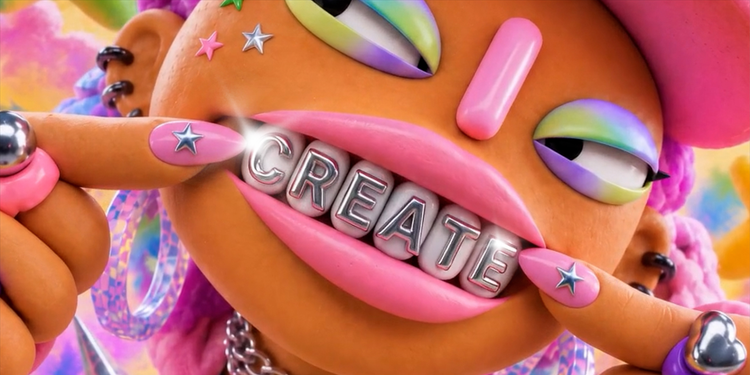
The director was Colombian Santiago Carrasquilla with his studio Art Camp. The film brings together animation, film, illustration, digital art and design in a deliberately varied visual world. Those involved include the illustrator Space Dawg (Michael Lim), the Ukrainian director Tanu Muiño, the Nigerian filmmaker Malik Afegbua and the beauty brand essie. A recurring motif is the word "Create", which appears in different materials and styles.
That very diversity is the message: creativity gets a recognisable face and a style of its own. With this, Adobe is selling more than the feature set of Photoshop or Firefly. The brand is trying to stand out in a growing range of interchangeable AI tools through its relationship with its creative community.
Adobe is showing the roughly one-minute film on its official video platform.
Less than a month from shoot to finished film
Especially revealing are the production details that Adobe has published. From shoot to final cut took, according to these details, less than a month. This figure explicitly describes the production phase, not the entire conception of the campaign.
Firefly was used when developing ideas and storyboards; Frame.io pooled videos, versions and feedback from the international team. Acrobat helped with documents and approvals, and its AI assistant with evaluating information for the brief. Workfront coordinated planning and resources. Individual artists also used Firefly to bring still images to life, and Photoshop and Premiere for specific design work.
That is an interesting contrast to the usual picture of an "AI campaign". The real efficiency gain here also comes from faster handovers, shared assets and clear decisions. Anyone planning elaborate creator spots knows how much depends on editing, coordination and usage rights – as the example of Grace Wells' 100-hour production shows.
The strategic shift becomes visible alongside new AI agents
Earlier in the spring, Adobe had already run a far more product-focused Firefly campaign with "Just Imagine". For a staging at New York's Times Square, according to Adobe's own retrospective, 392 image and video contents were coordinated across 38 displays in 30 formats. At that time, demonstrating AI production capabilities was especially close to the foreground.
With "Made to Create", the people involved now move to the fore. In parallel, on November 10, Adobe announced new Creative Agent features and Firefly workflows. These include, among other things, reusable creative workflows with Firefly Graph and a more controllable AI assistant. The message thus becomes part of the product strategy: software automates routine work and distribution, while people shape the idea, the style and the approval.
The tension between automation and recognisability has long since reached influencers and brands too. Our report on AI workflows and authenticity in the creator economy shows why the debate can no longer be reduced to "AI yes or no".
What social media teams can take away from the campaign
First: the creatives involved are themselves part of the distribution. A campaign with distinct artistic signatures provides hooks for portraits, making-of clips, artist interviews and vertical cutdowns. Adobe first released the film and has announced further variants for the coming months. Planned are, among other things, an adapted broadcast around the NFL Thanksgiving game as well as presence on television and streaming.
Second: a coherent workflow can matter more than any single generative model. When global teams produce many formats, versioning, feedback, localisation and creative control become success factors in their own right. Even with the Adobe–NHL partnership for personalised fan content, exactly this connection of creative assets and scale plays a role.
Third: the production style itself can carry the brand positioning. Especially in an environment where generated images quickly start to look alike, the visible choice of illustrators, film crews or stop-motion becomes a message. Our comparison of current Christmas campaigns between handcraft and AI also shows this.
For Adobe, "Made to Create" is therefore simultaneously a brand film, product proof and community narrative. The most interesting metric for now is not reach: Adobe demonstrates how contributions from many people can be brought together into one campaign in a short time without making their individual styles invisible.
Sources: Adobe – brand announcement (10.11.) · Adobe – behind the scenes of production (10.11.) · Adobe – Firefly updates at MAX (10.11.) · ADWEEK – coverage (11.11.)
Image: Official campaign visual "Made to Create", © Adobe.
Source