Magazine
Snapchat luxury study: purchase decisions increasingly happen in private chats
9.000 Luxury buyers from nine markets show how private chats, friends and AR try-ons influence purchase decisions. Snap, WPP and Ifop provide new data.
Contents · 4 sections
Luxury marketing is becoming more private: 62 percent of surveyed luxury buyers say chats directly influence their purchase decision. And 54 percent weight conversations with people they trust more heavily than public social media feeds. These are key findings of a study published on the 17 November 2026 by Snap, WPP Media and Ifop.
The study examined 9.000 people aged between 18 and 45 in nine markets who buy luxury products. It focuses on fashion, status, friendship circles and digital experiences. This explains a development that pure reach dashboards only partially capture: a public post sparks interest, but the decision often happens when forwarding, commenting and asking questions in a private chat.
Friends carry more weight than the next big influencer post
According to the original study by Snap and WPP, 81 percent of luxury buyers rely on the opinions of trusted people to confirm their decision. Among daily active Snapchat users, this share is 85 percent. Stories from close contacts are also named on Snapchat as a particularly useful source of inspiration for people interested in luxury.
For brands, this creates a different brief than chasing the maximally visible celebrity. Content must not only look high-quality but deliver something people willingly send to friends: an unusual cut, a surprising behind-the-scenes look, a new colour or a question worth actually discussing.
Snapchat naturally positions its own chat and AR environment as the answer. That is precisely why it is worth looking at the observed behaviour patterns, not just the advertising product recommendations of the commissioning party.
Luxury is experienced digitally before it is bought
76 percent of surveyed luxury buyers feel closer to the luxury world through social platforms; among daily Snapchatters it is 84 percent. At the same time, 65 percent feel that luxury has become less special than before. The challenge is obvious: brands can generate more interest through digital proximity, but must deliberately design exclusivity.
This starts well before the actual sale. 39 percent of buyers had at least four touchpoints with a product before purchasing. 79 percent think that anticipation between announcement and release adds to a product's value. For social campaigns, this argues for a sequence of material, craftsmanship and design stories, followed by a clear occasion to decide.
Along the same lines, 80 percent say that insights into the history, craftsmanship and production of an iconic product strengthen the desire to own it. A workshop video can therefore be more informative than the fifth glossy shot of the finished product.
AR is meant to bring trying on into discovery
The approach becomes most tangible with virtual product experiences. 71 percent say AR try-ons turn abstract interest into concrete desire. Among the people in the study who used an AR try-on on Snapchat, 66 percent reported a subsequent visit to a store or website; 54 percent reported a purchase.
These are self-reported figures from a study commissioned by Snap and WPP, not independently measured campaign conversions. The combination of digital trying on, private follow-up questions and a possible store visit is what stands out most.
Snapchat has been building products for these moments for some time. Our overview of the new Snapchat advertising strategy with creators and AI puts this development into context. For brick-and-mortar brands, the Snap Map study on local discovery shows how digital attention is meant to lead into stores as well.
What luxury and fashion brands can take from this
The study gives no reason to abandon feed campaigns. Rather, it shows where their impact often continues: in the non-public exchange. Anyone developing campaigns should therefore check whether their visuals, product stories and AR experiences invite sharing and discussion. Messaging, saved products, website visits and creator links then belong in reporting alongside reach metrics.
Our Snapchat Holiday Guide describes how purchase preparation already shifts into chats before the season begins. And the study on skepticism toward over-personalized AI advertising reminds us that closeness and trust should not be confused with maximum targeting.
Sources: Snap/WPP/Ifop – New Age of Luxury, 17. November 2026 · Snapchat for Business – Shopping Starts With The Inner Circle · Social Media Today, 17. November.
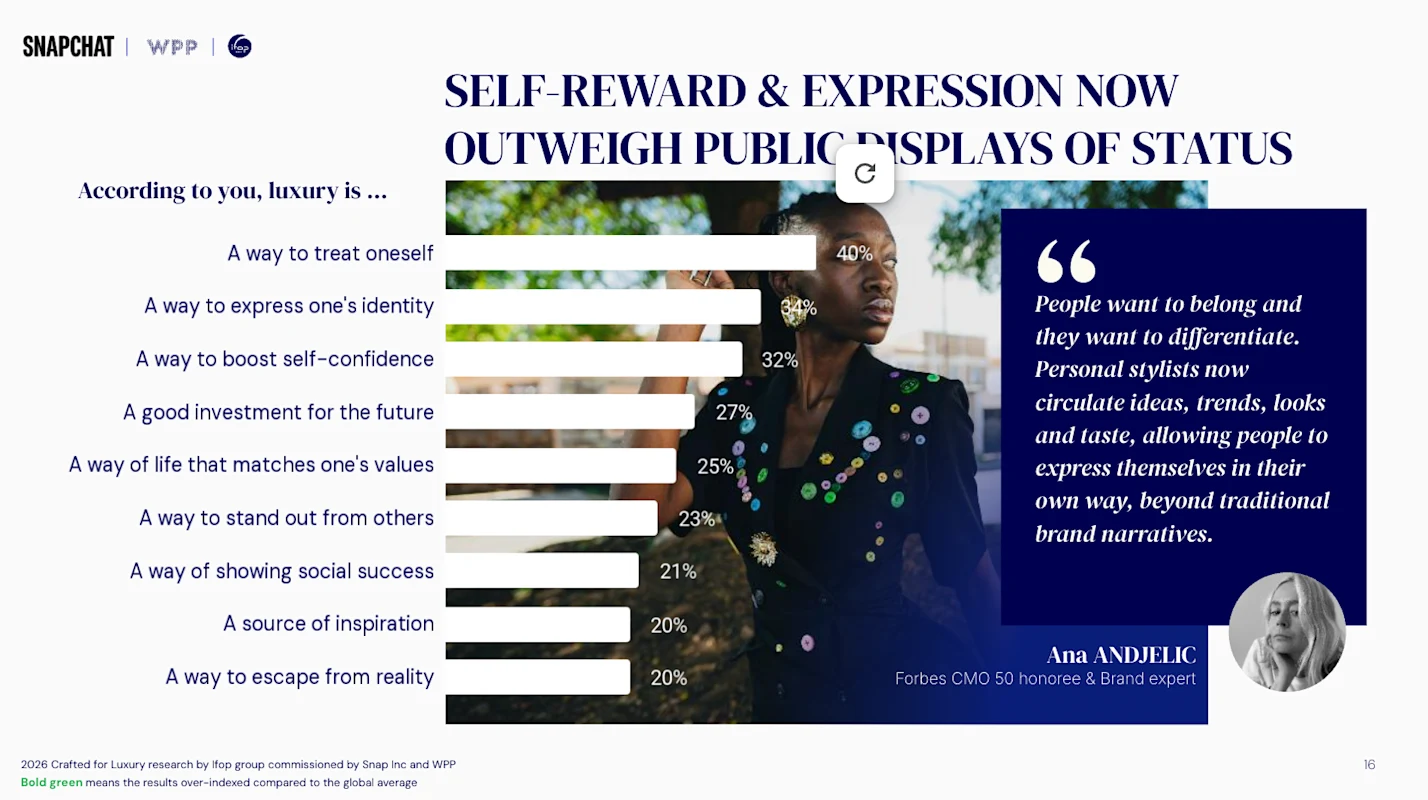
Image: Official study graphic from Snap Inc., WPP Media and Ifop, 2026.
Source