Magazine
Unilever steers 500.000 creators: 12 times more content at 90 percent lower unit costs
Unilever is restructuring its marketing 2027: 500.000 creators, AI-driven production and new search-engine KPIs. Why engagement is becoming more important than large TV buying budgets.
Contents · 5 sections
Unilever now works with more than 500.000 content creators and, by its own account, produces twelve times as much marketing content as 2024 – with unit costs down by 90 percent. The company presented the figures at its investor day on the 4 of November 2026. From 2027, a newly structured operating model with stronger central strategy and local execution is meant to roll this approach out across the entire brand portfolio.
The group behind Dove, Axe and Vaseline is signalling a shift in direction: advantage no longer comes simply from a big media buy, but from the ability to quickly develop content that fits individual communities, markets and platforms.
From 20.000 to 500.000 creators
About two years ago, Unilever put its network at roughly 20.000 creators. At the beginning of 2026, 300.000 was already being mentioned, and CEO Fernando Fernandez now cites more than 500.000. Their job is not to imitate a single big TV spot, but to translate products into the most varied everyday and community contexts.
According to the official investor day and the “Desire at Scale” programme, AI supports finding, briefing, checking and measuring these partnerships. Unilever's own analysis puts the return on investment of creator content at 1,5 times that of brand content alone. The comparison method was not disclosed in detail.
Dove's community activations with real product tests and reactions are an example of this logic. Vaseline's lotion swap in New York also shows how Unilever turns social conversation into product contact. The Axe relaunch with Y2K nostalgia takes a different cultural approach – but the same principle of local relevance.
Twelve times more content changes the cost equation
Unilever's marketing chief Leandro Barreto presented an AI-supported production process that turns one idea into many variants for different audiences, markets and channels. What used to take weeks, according to the presentation, can in certain cases be produced within hours. Overall, Unilever reports twelve times more content than 2024, at 90 percent lower cost per production unit.
The combination is economically interesting: more output and cheaper individual pieces do not automatically mean a smaller total budget. With twelve times the material and a tenth of the unit cost, total spending could arithmetically even end up slightly above the starting level. The real advantage lies above all in the number of ideas that can be tested and the speed of adjustment.
Unilever also reported higher purchase interest and better brand recall from Beauty & Wellbeing. In the official marketing model, brand identity remains central: AI content is meant to build on a consistent substantive foundation rather than simply churn out cheap variants.
We show how quickly the tools for this kind of video output are changing in our article on AI agents for social video production.
Four days, and the ad is already old
At the investor day, Fernandez described a video lifespan of sometimes only four days as a challenge of platform economics. After that, the additional return of individual creatives can even turn negative. Unilever therefore has to keep producing new variants and tracking their engagement, rather than relying on one master film for weeks.
The CEO also described the shift in bargaining power in the advertising market: platforms such as Meta, Google, TikTok, Amazon and Walmart reward the quality of the engagement generated. A large media budget therefore does not automatically buy the most efficient reach. Unilever puts its annual ROI improvements at roughly ten to 15 percent.
AI search is also becoming part of brand management
Alongside creator content, Unilever is investing in machine-readable product information and AI discoverability. According to the company, it now monitors more than one million search queries and prompts across over 30 markets. The aim is for brands to be represented as accurately as possible in AI answers and digital shopping assistants.
This adds a new layer to social-first: communities generate recommendations, content is tested at high frequency, and structured data is meant to carry that authority through to search engines and commerce agents. Which metrics make sense for this is explained in our report on AI visibility, source citations and AEO measurement.
What German marketing teams can learn from this
Unilever's figures do not assume that a mid-sized company engages hundreds of thousands of creators. Four organisational questions can be transferred: Who monitors community signals? Who quickly develops several creative variants? Who measures the effect by platform and target group? Who ensures the brand remains recognisable at speed?
The planned group reorganisation from 2027 makes clear how seriously Unilever takes these questions. Social and creator marketing will in future sit closer to product, growth and sales. For agencies and in-house teams, this is less a new posting frequency than a new production and decision-making model.
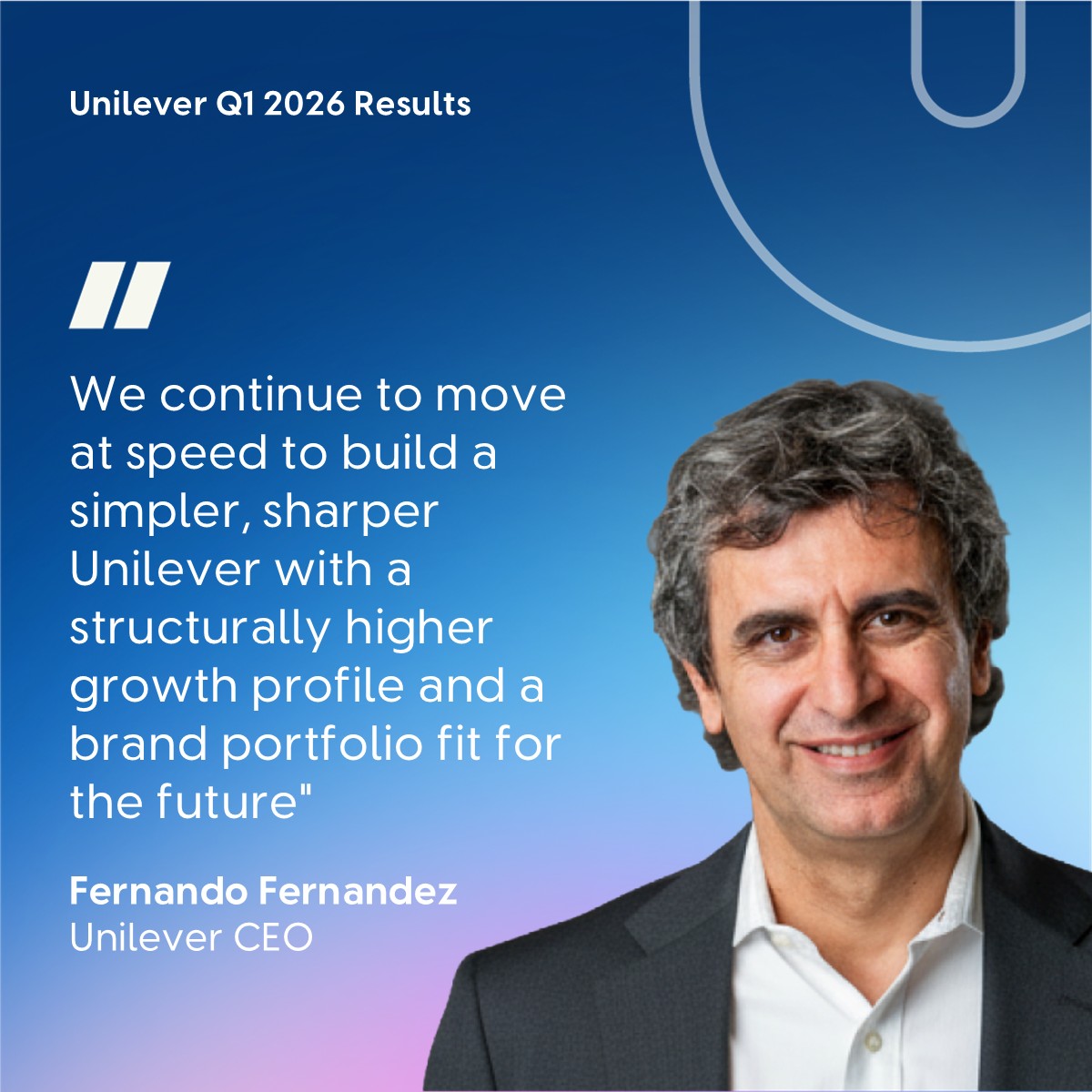
Image: Unilever, official archive photo with CEO Fernando Fernandez from the first quarter of 2026.
Sources - Unilever: Investor Event 2026 and Desire at Scale - Unilever: Marketing transformation / Desire at Scale - Original transcript of the investor day in text form: 500.000 Creator and production values - Marketing Dive: Unilever's social-first strategy and reorganisation
Source