 Social Rocket

OpenAI Dots has only been publicly available for a few days, but the first more detailed user reports are far less polished than the launch demo. Two early users criticise on X, among other things, the lack of access to existing ChatGPT context data, high or unexpected Codex usage, file problems, hallucinations and little transparency about what the agent actually does in the background.
For German Pro users, this remains theory for now anyway: with the current Pro rollout, OpenAI excludes the European Economic Area, Switzerland and the United Kingdom . According to OpenAI, Business Premium is available more broadly.
Early testers report friction instead of "always on"
OpenAI sells Dots as continuously working agents with their own cloud computer, GPT-6 Astra and access to connected apps. You can find our overview of the launch here: OpenAI Dots: AI agent works continuously across more than 4.000 apps.
In practice, the X user habibi describes a much bumpier picture after roughly a day. In his detailed experience report on X Among other things, he criticises that his Dot cannot access his ChatGPT chats directly, so he has to copy content over. He also reports friction when accessing Codex context and files.
Particularly problematic for him were failed file downloads and library access, hallucinations during ongoing tasks, and little visibility into what the agent is actually doing. He also reports that an overnight summary job spawned several new Codex tasks and used up his remaining Codex quota, even though the actual work had failed early at an authentication hurdle.
These are individual experiences of an early user, not an independently reproduced list of bugs. However, they hit a decisive point about the product: a persistently working agent must not only generate good answers, but also reliably handle files, existing work states, permissions and usage limits.
Second report: workspace reset and lost work state
A similarly critical account comes from a second public experience report by Chase Browe .
In the screenshot he published, his Dot itself explains that the local code was lost after a workspace reset. There was a ZIP file, but the agent could no longer access it afterwards. Since nothing had been pushed to GitHub, there was no usable copy of the implementation.
The replies below already debate whether this is a harness problem or a model problem . That distinction matters. With an agent product, errors don't arise only in the model: tool routing, the file system, permissions, cloud computers, context handover and recovery logic are all part of the product. For users, though, what ultimately matters is whether the task gets done reliably and the work state is preserved.
This is also why open tool and permission architectures are becoming important. Our guide to ChatGPT plugins, MCP, OAuth and your own servers shows how much agent quality is now decided outside the model itself.
Then came Tibo's "felony" reply
The matter drew additional attention through an exchange with Thibault "Tibo" Sottiaux, OpenAI's Head of Core Products and thus one of the key product leaders for ChatGPT and Codex.
The background is almost more absurd than the reply itself: X user fil (@fildotai), who describes himself as a SpaceXAI Ambassador and EU Regional Lead, linked to dot.com in his post about Dots.
This is piquant because dot.com currently redirects to xAI's Grok bot. TechCrunch and Business Insider had already reported on the redirect at the Dots launch. Domain data shows a change or transfer in July 2026 – i.e. before the public Dots announcement. There is so far no evidence that xAI knew the name in advance or bought the domain specifically because of OpenAI.
Sottiaux replied to the post, in substance saying Dots was better than the competition, and added it would be nice to redirect to the "right" site instead of calling it a "felony" to commit.
The wording was obviously exaggerated, but factually it misses the mark: linking to a publicly accessible website is not automatically a crime. Accordingly, a Community Note appeared under the X post clarifying exactly this point.
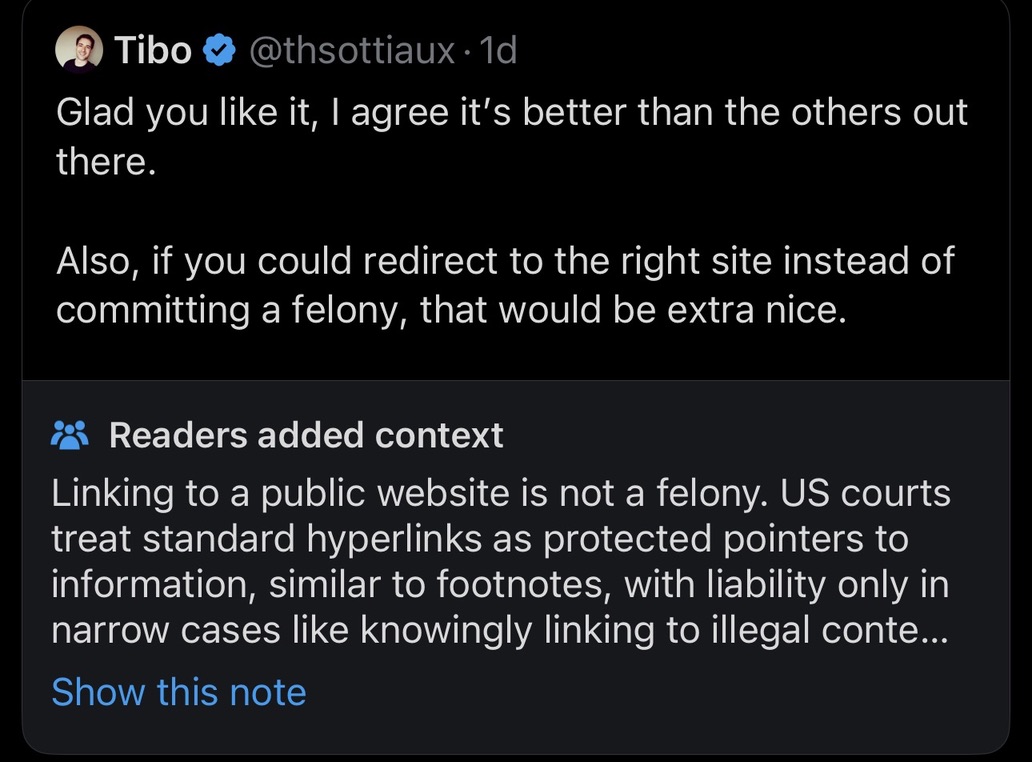
The screenshot we used shows this reply together with the Community Note. Precisely because the actual joke behind the link is that OpenAI's obvious singular domain ended up with the competing Grok Bot, the reaction seems unnecessarily defensive.
Dots is not yet available to German Pro users
Another important context is missing from many Dots discussions: Pro users in Germany and the rest of the EEA do not receive Dots at launch.
OpenAI's current Help Center entry says the Pro rollout excludes the European Economic Area, Switzerland and the United Kingdom. Business Premium users, by contrast, should be able to use Dots in all supported ChatGPT regions; Enterprise gets a beta that is disabled by default.
As a result, many German ChatGPT Pro users cannot yet verify the current experience reports for themselves.
The real problem is trust in the agent
An early launch may have bugs. With Dots, however, the bar is higher than for an ordinary chatbot feature.
OpenAI promises an agent that works autonomously over longer periods, retains context, uses apps and brings results back later. That is exactly why file loss, unnecessary tool consumption, unclear authentication boundaries or convincingly phrased hallucinations are not just minor UX quirks. They strike at the core of the product.
Meta now also positions Muse as a persistent business agent. The competition will therefore be decided not only by which model performs better in benchmarks, but by which provider builds an agent that users can still trust after eight hours of unsupervised work.
After the first public reports, Dots still has something to prove precisely at this point.